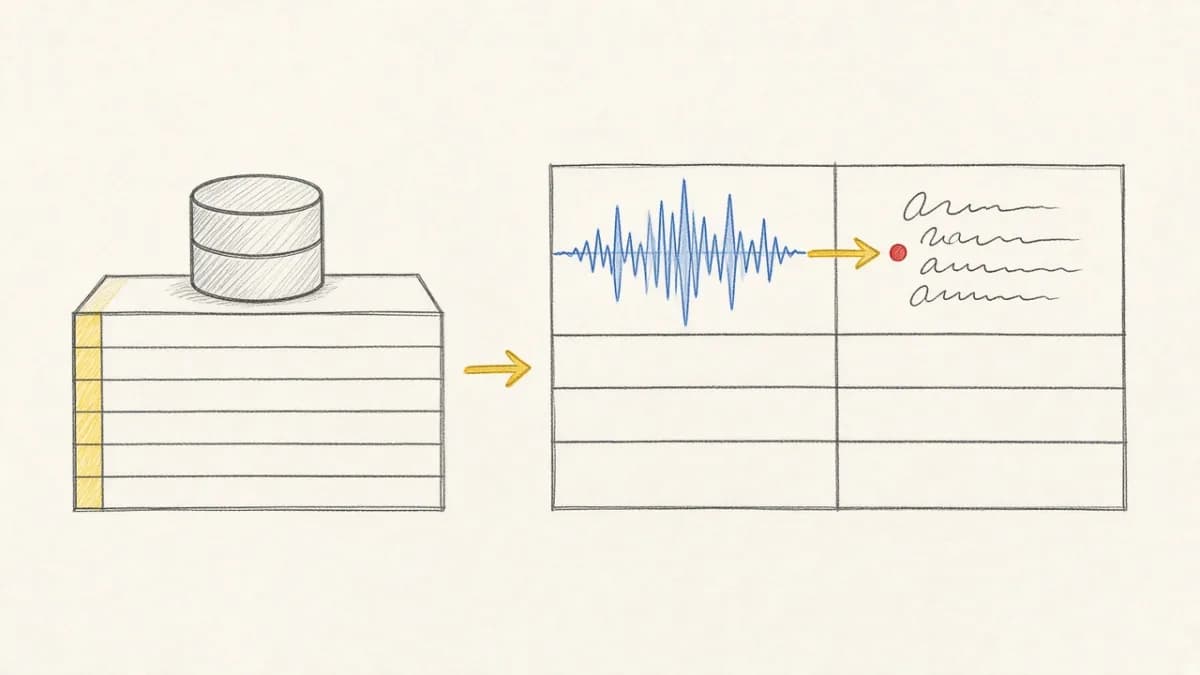
There's a recurring theme in conversations about AI development tools lately: "You don't need an eval framework." Sometimes Pixeltable gets lumped into this category, but Pixeltable is not an eval framework.
Pixeltable is data infrastructure for AI evaluation. And while you might not need an eval framework, you absolutely need robust data infrastructure to make evaluations scalable, reproducible, and practical.
What is Eval Data Infrastructure?#
Eval data infrastructure is the foundational layer that makes it possible to manage, process, and analyze the complex, multimodal datasets that power modern AI evaluations. It's what transforms evaluations from one-off experiments into reliable, repeatable processes that actually improve your AI systems.
Unlike traditional evaluation frameworks that focus on running tests and computing metrics, data infrastructure addresses the fundamental challenge: managing the data that makes evaluations possible.
Core Components of Eval Data Infrastructure#
Multimodal Data Management#
Modern AI systems work with images, videos, audio, documents, and structured data. Traditional eval frameworks struggle with this complexity, often requiring custom data loaders, format converters, and storage solutions for each data type. You need infrastructure that natively handles multimodal data as a first-class citizen.
Pixeltable treats images, videos, documents, and embeddings just like any other data type in a database. No more wrestling with file paths, S3 buckets, or format conversions. Your evaluation data lives in a unified, queryable structure.
Incremental Computation for Massive Efficiency#
The biggest pain point in evaluation workflows? Recomputing everything when your dataset changes. Add 100 new examples to a 10,000-item evaluation set, and traditional frameworks reprocess the entire dataset. This is expensive, slow, and wasteful.
Pixeltable's incremental computation engine only processes what's actually changed. Update your model? Only re-run inference on the evaluation data. Add new test cases? Only compute metrics for the new items. This isn't just an optimization; it's what makes iterative evaluation practical at scale.
Seamless Production Data Integration#
The best evaluations use real production data. But extracting examples from production systems, cleaning them, and preparing them for evaluation is complex, manual work. You need systems that can capture production traces, extract relevant examples, and seamlessly incorporate them into your evaluation datasets.
Pixeltable's declarative approach means you can define how production data should be transformed for evaluation once, and the system handles the ongoing synchronization automatically.
Built-in Versioning and Lineage#
Every evaluation result needs to be traceable back to the exact data, models, and processing steps that produced it. Traditional eval frameworks leave this to you: manually tracking dataset versions, model checkpoints, and code changes.
Pixeltable provides automatic versioning and lineage tracking. Every computed result (whether it's a model prediction, an embedding, or an evaluation metric) maintains a complete record of what data and code produced it. This isn't just nice-to-have; it's essential for reproducible AI development.
Scalable Processing Architecture#
Evaluation datasets are getting larger and more complex. A computer vision evaluation might include millions of images. A multimodal RAG evaluation might involve thousands of documents, each processed through multiple AI models. Traditional frameworks struggle with this scale.
Pixeltable is built for scale from the ground up. Its database-native architecture handles everything from small prototype evaluations to massive production datasets without requiring infrastructure changes or rewrites.
Why Data Infrastructure Matters More Than Frameworks#
Consider a typical multimodal AI evaluation workflow:
- Ingest evaluation data (images, videos, documents, text)
- Apply data preprocessing and feature extraction
- Run models to generate predictions
- Compare predictions against ground truth
- Compute evaluation metrics
- Analyze results and identify failure modes
Most evaluation frameworks focus on steps 4-6. But the real complexity (and where most teams get stuck) is in steps 1-3. That's where data infrastructure becomes critical.
A Real-World Example: Object Detection Model Evaluation#
Consider evaluating multiple object detection models against ground truth. Traditional approaches require complex data pipelines, manual result tracking, and custom evaluation code. Here's how Pixeltable's data infrastructure makes this seamless:
This single setup handles frame extraction, model inference, evaluation computation, and result aggregation, all with automatic caching, versioning, and incremental updates. Add new videos? Only the new frames are processed. Update a model? Only that model's results are recomputed.
Beyond Traditional Evaluations: Multimodal and Agentic Systems#
Modern AI systems are increasingly multimodal and agentic. A single evaluation might involve:
- Images processed through vision models
- Audio transcribed and analyzed
- Documents chunked and embedded
- Multi-step reasoning chains
- Tool usage and external API calls
Traditional evaluation frameworks weren't designed for this complexity. They excel at tabular data and simple input-output relationships, but struggle with the rich, interconnected data structures that modern AI systems require.
Pixeltable natively supports these complex evaluation scenarios through its multimodal data model and agent-aware architecture.
The same infrastructure principles apply to evaluating multimodal RAG systems, agent workflows, or any complex AI pipeline. Pixeltable handles the data complexity (document chunking, embedding generation, retrieval tracking) while you focus on defining what constitutes good performance.
The Infrastructure Advantage: Focus on What Matters#
Good infrastructure becomes invisible. When your evaluation data infrastructure works properly, you stop thinking about data management and start focusing on the evaluations themselves:
- What should we evaluate? Instead of "How do we manage this data?"
- Which metrics matter? Instead of "How do we compute this efficiently?"
- What do the results tell us? Instead of "Can we reproduce this experiment?"
This shift is crucial. The goal of evaluation isn't to run tests; it's to improve AI systems. Infrastructure that handles the complexity lets teams focus on insights, not data plumbing.
What About Eval Frameworks?#
The beauty of good data infrastructure is that it works with any evaluation approach. Whether you prefer:
- Custom Python scripts
- Notebook-based experiments
- Structured evaluation frameworks
- Automated CI/CD testing
Pixeltable provides the data foundation that makes all of these approaches more powerful. Dozens of teams use Pixeltable as the data layer underneath their preferred evaluation frameworks.
But Pixeltable also provides its own declarative evaluation patterns through the same AI Functions approach, with automatic versioning, caching, and lineage tracking built in.
Remember: the framework is optional. The infrastructure is essential.
Real-World Impact: Infrastructure in Action#
Computer Vision: From Days to Minutes#
A computer vision team was spending 2-3 days reprocessing their entire evaluation dataset every time they updated their model or added new test cases. With Pixeltable's incremental computation:
- Model updates: Only re-run inference, not data preprocessing (90% time savings)
- New test cases: Only process new images (95% cost reduction)
- Experiment tracking: Automatic lineage eliminates manual bookkeeping
Multimodal RAG: Scale Without Complexity#
A document AI company needed to evaluate their multimodal RAG system across thousands of technical documents containing text, images, and diagrams. Traditional approaches required separate systems for:
- Document storage and processing
- Image extraction and analysis
- Embedding generation and indexing
- Evaluation result tracking
Pixeltable unified all of this into a single, queryable system with automatic versioning and lineage tracking.
Getting Started with Eval Data Infrastructure#
Ready to move beyond ad-hoc evaluation scripts? Here's how to get started:
- Identify your data complexity: Are you working with multimodal data? Large datasets? Complex preprocessing pipelines?
- Start with a pilot evaluation: Choose one evaluation workflow that's currently painful or time-consuming
- Implement declaratively: Define what you want computed, not how to compute it
- Measure the impact: Compare development velocity, compute costs, and reproducibility
- Scale systematically: Expand to other evaluation workflows based on results
Start simple: define your evaluation data as tables, add computed columns for model predictions and metrics, then query for results. Pixeltable handles the rest: caching, versioning, incremental updates, and lineage tracking.
The Bottom Line: Infrastructure Enables Innovation#
The next time someone tells you "you don't need an eval framework," they're probably right. But you absolutely need robust data infrastructure for evaluation.
At Pixeltable, we focus on solving the hard infrastructure problems that make AI evaluation practical at scale:
- Multimodal data management that handles any data type natively
- Incremental computation that eliminates wasteful reprocessing
- Automatic versioning and lineage that ensures reproducibility
- Declarative workflows that focus on what, not how
Whether you use structured evaluation frameworks, custom Python scripts, or notebook experiments, Pixeltable provides the data foundation that makes your evaluations more efficient, reproducible, and scalable.
Good infrastructure becomes invisible: you stop thinking about data management and start focusing on building better AI. That's the real test of infrastructure: when it works so well that you forget it's there.
Ready to transform your AI evaluation workflows?