The Challenge: Why is Multimodal AI Data Pipeline Complexity So High?#
Building robust AI applications, especially those dealing with multimodal data (images, video, audio, documents), often requires wrestling with a complex web of specialized tools – a situation many developers call "data plumbing hell." This AI data pipeline complexity arises from stitching together numerous components:
- ETL Pipelines: For loading, cleaning, and transforming diverse data formats.
- Vector Databases: For enabling semantic search and retrieval (learn about Pixeltable's integrated approach).
- Feature Stores: For caching and serving ML features consistently.
- ML Orchestration Tools: For scheduling and managing dependencies between jobs.
- Model Serving Infrastructure: For deploying and managing inference models.
- Ad-hoc Systems: Often needed for critical tasks like parallelization, caching, versioning, and lineage tracking.
Integrating these disparate systems (ETL, vector DB, orchestration, etc.) is not just technically challenging; it dramatically slows development, inflates costs, makes the entire MLOps stack brittle, and hinders reproducibility.
Introducing Pixeltable: A Declarative AI Data Infrastructure#
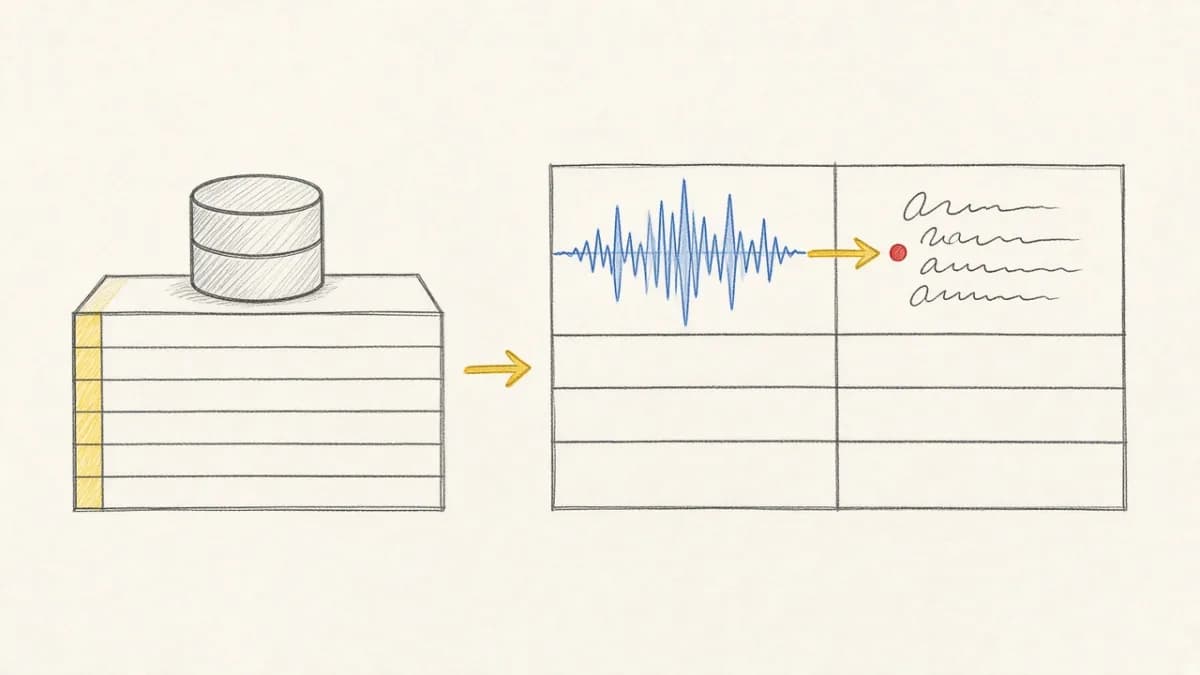
What if you could replace this fragmented setup with a single, coherent framework? Pixeltable provides exactly that: a unified multimodal AI infrastructure built on a declarative philosophy. Similar to how SQL abstracts database operations, Pixeltable allows you to define your entire AI data workflow declaratively using Python.
Instead of manually coding *how* data moves and transforms, you declare *what* results you want using Pixeltable's table interface. The Pixeltable engine intelligently handles the underlying "data plumbing," managing storage, computation, indexing, and orchestration automatically.
How Pixeltable Unifies ETL, Vector Search, and Feature Management#
Pixeltable directly addresses the core challenges of fragmented AI data infrastructure:
- Unified Data Management: Tables directly reference external files (video, audio, images, docs) and structured data. Say goodbye to complex ETL setup for basic ingestion.
- Integrated Transformation & AI: Define processing steps (transformations, feature extraction, model inference) as computed columns using built-in functions or your own Python UDFs. Pixeltable orchestrates the execution.
- Built-in Vector Search: Add embedding indexes directly to tables/views. Pixeltable manages the embedding computation and indexing lifecycle, often eliminating the need for a separate vector database.
- Automatic Incremental Computation: Pixeltable's core strength. It tracks dependencies and only recomputes necessary outputs when data or functions change, drastically reducing processing time and cost compared to full pipeline reruns. This is key for efficient AI development.
- Effortless Versioning & Lineage: Data and schema changes are automatically tracked, ensuring reproducibility and simplifying debugging.
- Simplified Orchestration: Dependencies are managed implicitly through the declarative definition of computed columns.
Benefits: Simplifying the MLOps Stack and Accelerating Development#
Adopting Pixeltable's unified multimodal AI infrastructure translates to tangible advantages:
- Simplify MLOps Stack: Consolidate multiple tools into one framework, reducing integration complexity and maintenance overhead.
- Faster AI Development: Spend less time on infrastructure setup and data plumbing, and more time iterating on core ML logic and building features.
- Cost Efficiency: Incremental computation significantly reduces unnecessary processing, lowering compute costs.
- Improve ML Reproducibility: Automatic versioning and lineage make it easy to track how results were generated and reproduce experiments.
- Reduce AI Pipeline Brittleness: A unified system is less prone to failures caused by complex inter-tool dependencies.
- Focus on ML Logic, Not Infrastructure: Pixeltable handles the heavy lifting, letting your team concentrate on the unique aspects of your AI application.
Conceptual Example: From Complex Pipelines to Declarative Tables#
Consider building a video analysis pipeline that extracts frames, generates descriptions, and creates a searchable index:
Traditional Approach (Simplified): Requires separate scripts/tools for ingestion (ETL), frame extraction (e.g., FFmpeg), description generation (model serving endpoint), embedding (another script/service), indexing (vector DB), and an orchestrator to tie it all together.
Pixeltable Approach (Declarative Python):
This declarative Python AI data framework manages the entire process (execution, storage, incremental updates, and lineage) automatically.
Conclusion: Build Faster with Unified Multimodal AI Infrastructure#
Stop drowning in AI data plumbing complexity. Pixeltable offers a powerful, simpler alternative by providing a unified multimodal AI infrastructure. Its declarative approach, combined with automatic incremental computation and built-in versioning, allows teams to build, iterate, and deploy sophisticated AI applications faster and more reliably.
Ready to simplify your MLOps stack and focus on innovation?
- Start with Our Beginner Tutorial - Build a smart image organizer in 10 minutes
- Try Pixeltable on GitHub
- Check out the Getting Started Guide
- Join our Discord Community