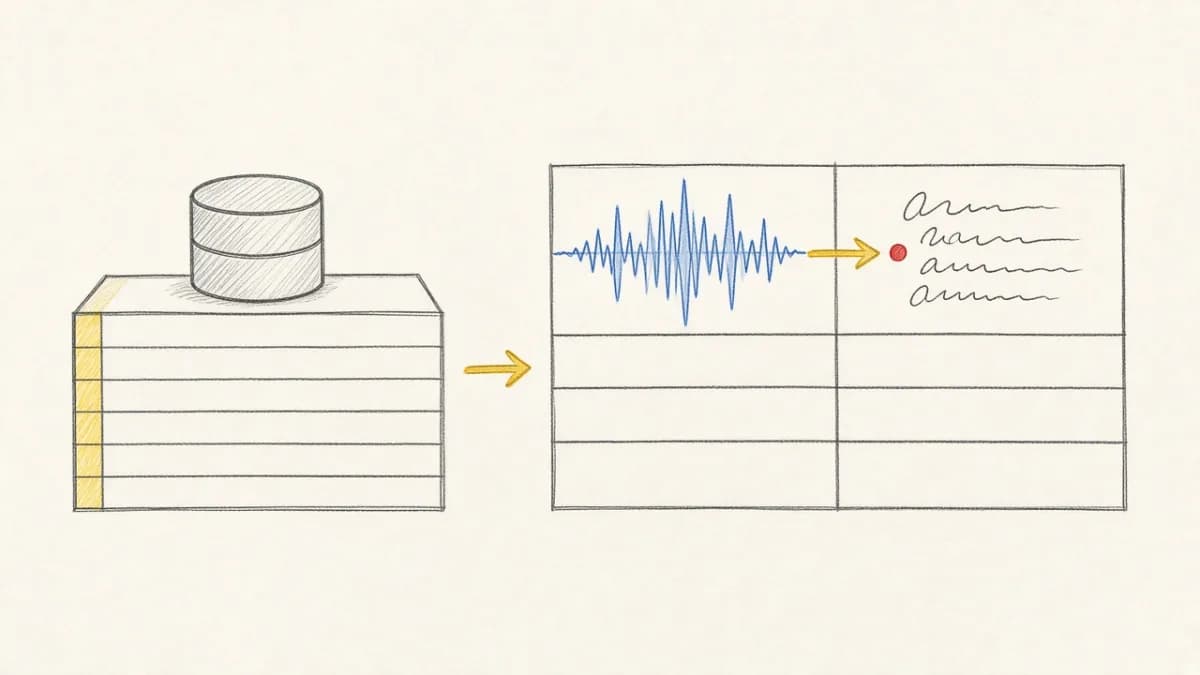
Summary: Lovable and Bolt democratized building applications for people who do not write backends for a living. You describe the product; a working app appears. Pixeltable is the same kind of move for a different persona: developers building multimodal AI. It is still a technical framework, written by people who have shipped database engines. The lovable part is the surface. Tables, computed columns, and one app.py replace the set of services you used to assemble by hand. Data management, orchestration, and serving stop being a second job, so you can iterate, maintain, and productionalize applications that actually use video, images, audio, and documents.
Two Democratizations#
The last two years made a specific kind of software feel obvious. Tools like Lovable and Bolt collapsed "how do I ship a web app?" for a non-technical persona. You no longer need to rent a designer, a frontend engineer, and a weekend of auth-and-CRUD glue to get a first version in front of a user.
That is a real democratization. It is also a different job from the one multimodal AI developers have.
A developer who wants a RAG app over PDFs, a video search pipeline, or an agent with durable memory is not blocked on buttons and routes. They are blocked on a stack of services that do not know about each other: object storage for media, a warehouse or Postgres for metadata, an orchestrator for transforms, a vector database for embeddings, and a serving layer to expose the result. Each piece is fine. The surface area of the set is what makes multimodal feel unlovable.
Pixeltable's claim is not "now non-engineers can build multimodal AI." The claim is that developers should get the same collapse Lovable gave product people: a small surface over a hard problem, so the first version and the tenth revision are the same kind of work.
| Lovable / Bolt | Pixeltable | |
|---|---|---|
| Persona | Non-technical builders, PMs, founders | Developers shipping multimodal AI |
| What got democratized | Shipping an application from a prompt | Shipping a multimodal data app from a schema |
| Artifact | A running UI and backend scaffold | One app.py: tables, computed columns, HTTP |
| What disappeared | Framework choice, auth boilerplate, first deploy | Object-store sync, DAG files, vector-index drift, staging glue |
| What is still hard | Taste, distribution, the product itself | The model, the prompt, the data, the evaluation |
These are complementary, not competitive. A team can vibe-code a frontend in Lovable and keep the multimodal data plane in Pixeltable. The metaphor is about who gets a smaller surface, not about replacing one product with the other.
What "Lovable" Means for a Technical Product#
Pixeltable is not a no-code builder. It is a Python framework and a catalog. The people who built it come from database engines, not from prompt-to-app. That is the point.
A lovable technical product is not one that hides expertise. It is one that spent the expertise on the right abstractions, so users do not have to re-derive them. Postgres is lovable in that sense. Git is lovable in that sense. You still have to think. You no longer have to invent storage, history, or a working tree.
For multimodal AI, the right abstractions are not "another orchestration YAML" or "another embedding API." They are:
- A table that can hold media.
Video,Image,Audio,Documentare column types, not paths you babysit. See what a multimodal data table is. - Transforms as columns. Transcription, frames, captions, embeddings are declared next to the source. Insert a row; the work runs. Change the model; only dependents recompute.
- One file that is the backend.
TableModelplusFastAPIRouterinapp.py. Apply it. Serve it. The same file is what you take to Cloud.
That is a small surface over three historically separate products: data management, orchestration, and serving. We wrote the infrastructure version of this in what "dead simple" actually requires and in storage, orchestration, and retrieval as one system. This post is the persona version: the reason those decisions feel like Lovable, if Lovable were built for people who write Python and care about lineage.
The Surface That Disappeared#
Ask a team how they productionalize multimodal AI today and you will hear a list of services. The list is not the problem. The joints are the problem.
- Object-store sync. Bytes in a bucket, IDs in a database, a script that hopes they still match.
- DAG files. An orchestrator that re-runs a world because it cannot see which cells changed.
- Vector-index drift. Embeddings in a second system that nobody invalidates when the source row dies.
- Staging glue. A cluster you rent so "dev" vaguely resembles "prod," because the engine only exists as a cloud.
None of that is the application. It is the tax you pay before you can change a chunker or a prompt. A lovable multimodal framework deletes that tax from the default path. You still choose models. You still evaluate retrieval. You do not maintain a private platform team to keep S3, Airflow, and Pinecone in a shared hallucination.
If you have already felt week two of a vibe-coded pipeline, we wrote that failure mode separately: why vibe-coded AI apps break in production. This essay is the other half. The prototype should have been declared on infrastructure that already versions, incrementally recomputes, and serves.
Iterate, Maintain, Productionalize#
Lovable won on time-to-first-app. Developers need that and time-to-change-the-model. Multimodal systems are experimental: new media, new chunking, new embeddings, new prompts. If each change restages three services, you stop iterating. If each change is a column, you keep going.
That is the loop we want to be obvious:
Insert a row. The computed column runs. Change the model or the prompt; lineage decides what to recompute. Add an embedding index when you need search. Expose insert and query over HTTP from the same file. That is iterate, maintain, and productionalize as one activity, not three migrations.
Promotion is the same artifact, not a rewrite. Apply locally, serve locally, apply the same app.py to Pixeltable Cloud. Why that local-cloud loop is the actual developer lifecycle — and why cloud-only clusters made it expensive — is the sibling essay: why the local-cloud loop matters. The schema you keep is now class-based TableModel: Never Fuck With Your Backend Anymore.
What This Is Not#
It is not a claim that multimodal AI is now a weekend toy. Media is large. Models fail. Evaluation is real work. Pixeltable does not delete that. It deletes the fake work of assembling a data plane every time you want to try a better captioner.
It is not "don't use Lovable." Use Lovable for the product surface if that is your team. Use Cursor or Claude for the application code. Those tools are excellent at UI and glue. They are not a multimodal catalog. When the assistant writes a one-off embed-and-upsert script, it is optimizing for the demo. The framework should already own versioning, incremental compute, and serving so the demo and production are the same declarations.
And it is not a no-code pitch to the Lovable user. If you do not want a schema, Pixeltable is the wrong product. If you do want a schema, and you are tired of treating storage, orchestration, and serving as a shopping list, it is the right one.
People Also Ask#
Is Pixeltable a no-code builder like Lovable or Bolt? No. Pixeltable is a Python framework and catalog for developers. The Lovable comparison is about persona and surface area: they made shipping apps obvious for non-technical builders; Pixeltable makes shipping multimodal AI data apps obvious for people who write code.
Do I still need Pinecone, Airflow, and an object store? Not as a default architecture. Media, computed transforms, embedding indexes, and HTTP live in one system. You can still export or bring your own bucket. You should not need a sync job to keep those three products from drifting. See what compounds when they live in one place.
Should I use Lovable or Pixeltable? Different jobs. Lovable (and Bolt) are for building the application people click. Pixeltable is for the multimodal data plane behind that application: tables, derived media, indexes, and the API those clicks hit.
Who is Pixeltable for? Developers and technical teams building RAG, video intelligence, document pipelines, or agents that have to remember media. If your bottleneck is "I cannot draw a UI," start with a vibe-coding tool. If your bottleneck is "I cannot keep transcripts, frames, and embeddings honest," start here.
Make the Hard Part Small#
Lovable made application-building lovable by shrinking the surface for a non-technical persona. Multimodal AI is still a technical problem. The way to make it lovable is not to pretend otherwise. It is to hide the services that were never the product: data management, orchestration, and serving.
Declare the table. Compute on insert. Serve the same file. That is the abstraction we think developers actually wanted.
- Pixeltable on GitHub:
pip install pixeltable - Get started: CLI, Skill, and the one-file loop
- The Unified Multimodal Backend Agents Build With: the identity essay — one file is the backend
- Why the Local-Cloud Loop Matters: the sibling essay on promotion and hybrid execution
- Never Fuck With Your Backend Anymore: class-based
TableModeland the 2026 recap - Pixeltable documentation