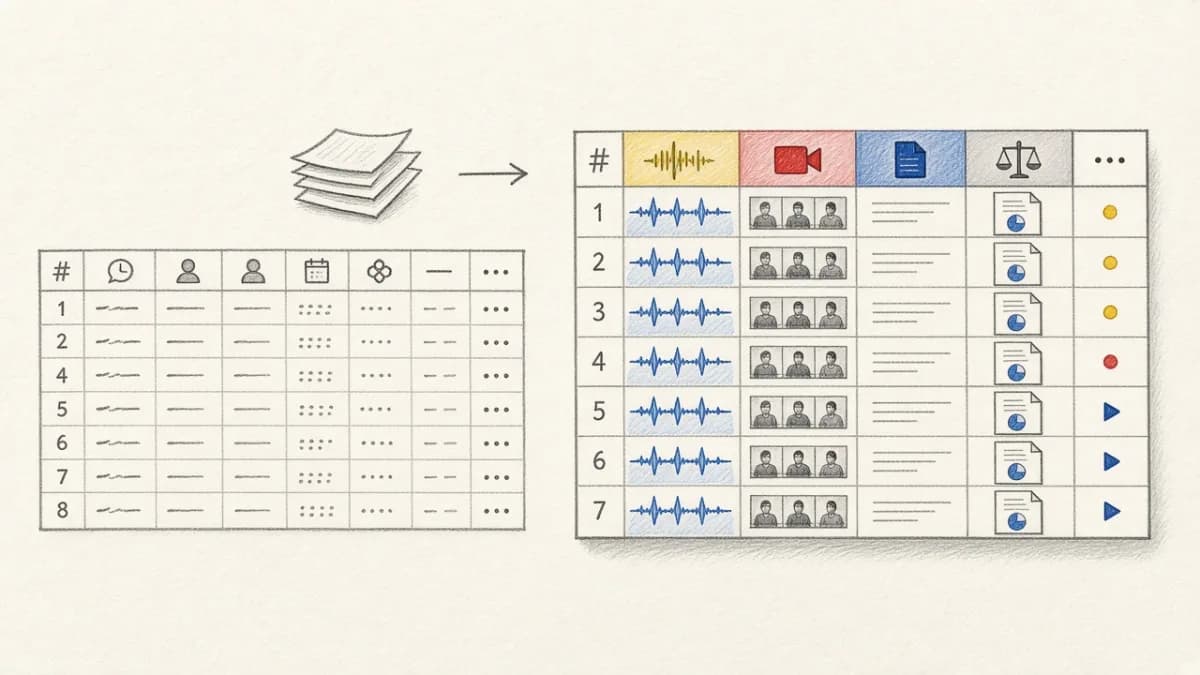
The modern AI stack is broken. Not because the individual tools are bad, but because they weren't designed to work together. Here's why the "best-of-breed" approach is creating a maintenance nightmare, and how to fix it.
The State Synchronization Problem#
Every AI team starts with a simple goal: build a RAG app, a video search engine, or a classification pipeline. They grab the standard tools:
- S3 for raw media storage
- Postgres for metadata
- Pinecone/Weaviate for embeddings
- Airflow/Dagster for orchestration
Individually, these are powerful. Together, they create what we call the Frankenstein Stack. The core issue isn't the tools themselves; it's the glue code required to keep them in sync.
The Anatomy of a Bug#
Consider a simple requirement: "Delete a video from our dataset." In a unified system, this is one command. In the Frankenstein Stack, it's a distributed systems problem:
- Delete the file from S3.
- Delete the metadata row from Postgres.
- Find and delete the associated vectors in Pinecone.
- Update any cached inference results.
If step 3 fails, you now have "zombie vectors": embeddings that point to non-existent data. Your search results return broken links. Your RAG app hallucinates context that doesn't exist.
The Cost of Glue Code#
We analyzed dozens of production pipelines. On average, 40-60% of the codebase is just glue code: scripts to move data, handle retries, manage state, and sync indexes.
Here's what a typical "simple" ingestion script looks like:
This code is brittle. It doesn't handle partial failures well. It doesn't handle updates (what if the video file changes?). It doesn't track lineage.
The Unified Approach#
Pixeltable takes a different approach: Declarative Data Infrastructure. Instead of writing imperative scripts to move data between systems, you define the relationships between your data, and the system handles the orchestration.
Here is the same pipeline in Pixeltable:
This isn't just fewer lines of code. It's a fundamental architectural shift:
- Atomic Updates: When you insert a video, frames are extracted, embeddings generated, and indexes updated in a single transaction.
- Incremental Updates: If you change the frame extraction rate, Pixeltable only recomputes what's necessary.
- Unified Lineage: The system knows that the embedding depends on the frame, which depends on the video. No more zombie vectors.
Stop Building the Frankenstein Monster#
The "best-of-breed" approach works for mature, decoupled problems. But AI workflows are tightly coupled: data, code, and models are inextricably linked. Treating them as separate concerns handled by separate tools is the root cause of the "data plumbing hell" teams face today.
By adopting a unified infrastructure like Pixeltable, you eliminate the glue code tax and get back to what matters: building better models and shipping features.
Ready to dismantle your Frankenstein stack? Read AI Transformations Belong in the Schema for the architectural alternative, check out our guide for ML Engineers, or try the Quick Start.