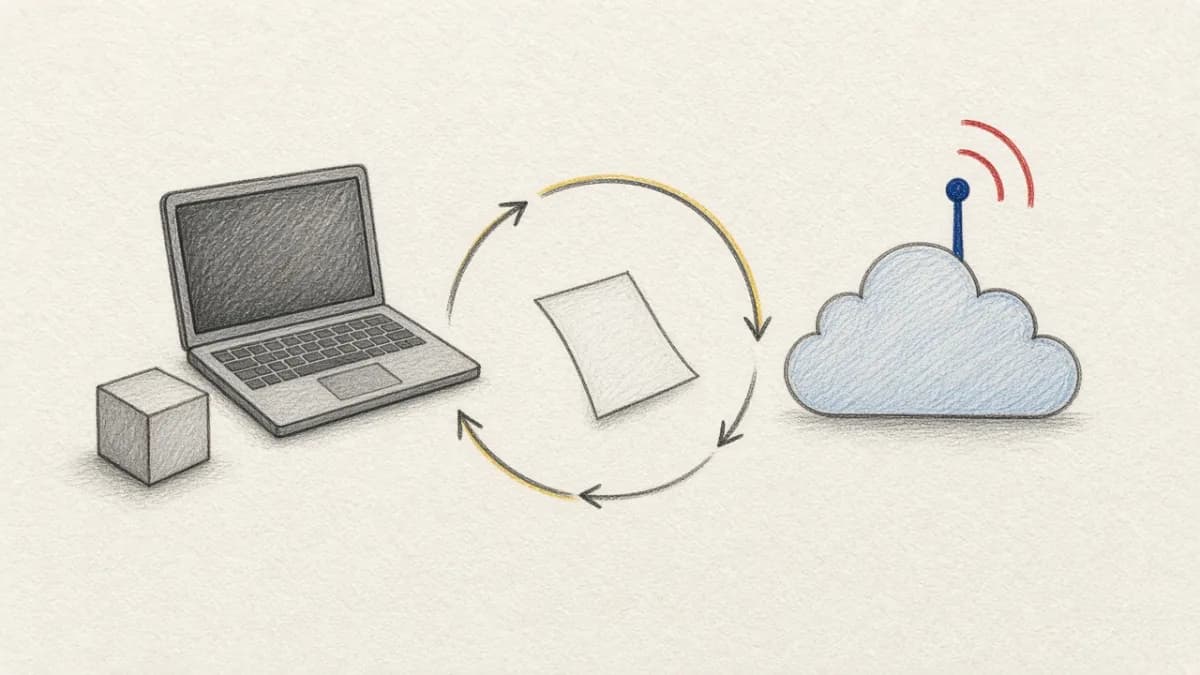
The Great AI Production Gap: Where Innovation Goes to Die#
Your AI prototype is working beautifully. The model is accurate, the demo is impressive, and stakeholders are excited. You're ready to scale to production. Then reality hits.
What seemed simple in development becomes a months-long engineering nightmare. Your elegant Jupyter notebook transforms into a complex orchestration of microservices, databases, message queues, and monitoring systems. The prototype that took weeks to build requires a complete rewrite and a team of infrastructure engineers to make production-ready.
This is the AI production gap, and it's killing 80% of AI projects before they reach real users. Based on extensive interviews with over 200 ML engineers, data scientists, and AI platform teams, we've uncovered the hidden infrastructure challenges that separate successful AI deployments from failed experiments.
The Brutal Statistics of AI Production Failure#
The numbers are sobering, but they align with what every AI practitioner experiences:
- 80% of AI projects never reach production according to industry studies
- 87% of data science projects never make it to production (VentureBeat, 2024)
- Only 22% of companies have successfully deployed AI models (McKinsey, 2024)
- $10.9 billion wasted annually on failed AI initiatives (Gartner, 2024)
"We spent 4 months just building the infrastructure to deploy our model. The AI logic itself took two weeks. The real challenge often lies underneath the orchestration layer." (Engineering Lead at an AI startup)
This isn't a failure of AI technology. It's a failure of infrastructure. The same models that work brilliantly in prototypes fail in production not because they're inaccurate, but because the infrastructure supporting them is fragile, expensive, and unmanageable.
Anatomy of AI Production Failure: The Five Critical Gaps#
1. The Development-Production Architecture Gap#
The most devastating failure mode: architectures that work in development break completely in production.
Development Reality:
- Single machine with local files
- Jupyter notebooks with manual execution
- Small test datasets
- Manual error handling
- No concurrent users
Production Requirements:
- Distributed systems with network failures
- Automated orchestration with complex dependencies
- Massive datasets requiring incremental processing
- Robust error handling and recovery
- Thousands of concurrent requests
"Moving R&D projects into production... developers need to understand a large tech stack. The gap is enormous." (Blackshark.ai Engineering Team)
2. Infrastructure Complexity Explosion#
What starts as a simple AI model becomes a distributed systems nightmare:
Teams that set out to build AI features end up building distributed systems platforms. One customer reported hiring 20-30 engineers just to manage production infrastructure for their AI models.
3. The Cost Scaling Crisis#
Production AI costs spiral out of control due to inefficient infrastructure:
GPU Utilization Disaster#
- Only 30-40% typical GPU utilization reported across interviews
- Idle time during data loading and preprocessing
- Poor batching strategies leaving compute resources unused
- Network bottlenecks between storage and compute
Cloud Cost Explosion#
"We need a 10x cost reduction to make our AI use case economically viable at scale." (Engineering Director at a financial services company)
- Redundant processing: Recomputing results that haven't changed
- Data transfer costs: Moving data between systems constantly
- Over-provisioning: Scaling infrastructure for peak loads
- Vendor sprawl: Paying for multiple specialized services
4. The Production Evaluation Crisis#
Evaluation strategies that work in development completely break down in production:
Development Evaluation:
- Static test sets with known ground truth
- Batch processing with unlimited time
- Manual review of failure cases
- Simple accuracy metrics
Production Reality:
- Streaming data with no ground truth
- Real-time constraints (30ms response time)
- Automatic monitoring at scale
- Complex business metrics beyond accuracy
"Evaluation is an open question... we can't use established techniques. Running multiple LLMs to find disagreements, then manually reviewing. It's not sustainable." (Aurora Coop Engineering Team)
5. The Tool Integration Nightmare#
Production systems require integrating dozens of specialized tools, each with different APIs, data formats, and failure modes:
- Data Storage: S3, PostgreSQL, Redis, specialized databases
- Vector Search: Pinecone, Weaviate, Milvus, custom solutions
- Model Serving: SageMaker, Ray Serve, custom endpoints
- Orchestration: Airflow, Temporal, Kubernetes jobs
- Monitoring: MLflow, Weights & Biases, custom dashboards
- Security: IAM, VPCs, encryption, compliance tools
"No single tool that handles everything... too many cobbled-together tools. The integration complexity is overwhelming." (AMP Robotics Platform Team)
Industry-Specific Production Challenges#
Healthcare: Regulatory Compliance Meets AI#
Healthcare AI faces unique production challenges:
- Data residency: Patient data cannot leave secure environments
- Audit trails: Complete lineage required for FDA approval
- Performance requirements: 99.9% accuracy isn't good enough: lives depend on precision
- Integration complexity: Must work with legacy hospital systems
"90% accuracy with medical diagnoses equals failure. Our production requirements are unforgiving." (AI Research Director at a major health system)
Autonomous Vehicles: Real-Time Everything#
Autonomous systems demand ultra-low latency with perfect reliability:
- Latency requirements: 30ms maximum response time for safety
- Multi-sensor fusion: Camera, LiDAR, radar data in real-time
- Edge deployment: Processing must happen in vehicles, not cloud
- Safety certification: Every component must be verified and traceable
Financial Services: Scale and Compliance#
Financial AI requires massive scale with zero tolerance for errors:
- Transaction volume: Billions of events processed daily
- Regulatory oversight: Every decision must be auditable
- Cost sensitivity: Infrastructure costs directly impact profitability
- Latency requirements: Millisecond response times for trading
Why Traditional Production Approaches Fail#
Enterprise ML Platforms: Too Much Overhead#
Platforms like Databricks and SageMaker promise to solve production challenges but often create new ones:
- Complexity tax: Weeks to configure for simple workflows
- Vendor lock-in: Proprietary APIs prevent flexibility
- Over-engineering: Enterprise features for prototype needs
- Learning curve: Teams need specialized platform expertise
"Databricks is not a good product; everything is very mediocre. We need something that works, not something that promises everything." (Principal Engineer at a data-driven company)
Microservices Hell: The Orchestration Nightmare#
Teams often decompose AI workflows into microservices, creating operational complexity:
The result: engineers spend more time debugging distributed systems than improving AI models.
Custom Pipeline Brittleness#
Teams building custom production pipelines face systematic failures:
- Single points of failure: One component breaks, entire pipeline stops
- Data consistency issues: Race conditions between pipeline stages
- Manual recovery: No automated error handling or retry logic
- Performance degradation: No optimization as data volume grows
The Production-Ready Approach: How Successful Teams Deploy AI#
The teams that successfully deploy AI to production share common architectural patterns and tool choices. Here's what actually works:
Unified Infrastructure: Development Equals Production#
The most successful teams eliminate the development-production gap entirely by using the same infrastructure for both:
Incremental Architecture: Process Only What Changed#
Production systems need incremental processing to handle scale economically:
"We went from $50,000/month in compute costs to $8,000/month by switching to incremental processing. Same results, 84% cost reduction." (ML Platform Lead at a media company)
- New data: Only process new videos/images/documents
- Model updates: Only recompute affected predictions
- Pipeline changes: Cascade updates efficiently
- Error recovery: Retry only failed operations
Built-in Production Monitoring#
Successful teams build observability into their AI systems from day one:
Production Cost Optimization: Making AI Economically Viable#
Intelligent Resource Management#
Production AI systems must optimize resource usage automatically:
Cost Transparency and Control#
Teams need visibility into AI costs to optimize spending:
Production Evaluation: Beyond Prototype Metrics#
Continuous Evaluation in Production#
Production AI systems need evaluation that works with real, streaming data:
Automatic Edge Case Discovery#
Production systems must automatically identify failure modes without manual inspection:
Success Stories: Teams That Beat the Production Gap#
Computer Vision Security Company#
A security company processing surveillance footage 24/7:
- Challenge: Process thousands of video streams in real-time
- Traditional approach: 6-month infrastructure project with 15 engineers
- Pixeltable approach: 2-week deployment with existing team
- Results: 95% reduction in infrastructure complexity, 60% cost savings
Healthcare AI Research Lab#
A medical imaging lab deploying diagnostic AI:
- Challenge: FDA compliance requiring complete audit trails
- Traditional approach: Custom lineage tracking system
- Pixeltable approach: Built-in versioning and lineage
- Results: Faster regulatory approval, reproducible studies
Autonomous Robotics Company#
A robotics company deploying edge AI for manufacturing:
- Challenge: 30ms latency requirements with 99.9% uptime
- Traditional approach: Complex edge orchestration system
- Pixeltable approach: Unified pipeline deployable anywhere
- Results: Met latency requirements with 80% less infrastructure code
Production AI Readiness Checklist#
Use this checklist to assess whether your AI project is truly production-ready:
Architecture Readiness#
- ☐ Unified data model: All data types handled in one system
- ☐ Incremental processing: Only recompute what's changed
- ☐ Automatic scaling: Handle load spikes without manual intervention
- ☐ Built-in monitoring: Quality metrics tracked automatically
- ☐ Disaster recovery: System can recover from any failure
Operational Readiness#
- ☐ Cost visibility: Know exactly what each operation costs
- ☐ Performance SLAs: Meet latency and throughput requirements
- ☐ Quality assurance: Continuous evaluation in production
- ☐ Security compliance: Meet industry-specific requirements
- ☐ Team knowledge: Multiple team members can operate the system
Business Readiness#
- ☐ Economic viability: Unit economics make sense at scale
- ☐ Competitive advantage: AI provides sustainable business value
- ☐ Market validation: Users actually want the AI features
- ☐ Regulatory approval: Compliance requirements met
- ☐ Support infrastructure: Team can maintain and improve the system
Building Production-First: The Pixeltable Approach#
Pixeltable was designed specifically to eliminate the development-production gap. Every feature is built with production deployment in mind:
Production-First Architecture#
- Same code everywhere: Development environment equals production
- Automatic optimization: Built-in batching, caching, and resource management
- Native monitoring: Performance and quality metrics included
- Incremental updates: Handle scale without reprocessing everything
Real Production Example: Content Moderation at Scale#
From Cost Center to Competitive Advantage#
Teams that solve the production challenge transform AI from a cost center into a competitive advantage:
Development Velocity Advantage#
- Faster iteration: Test new models and features rapidly
- Reduced complexity: Engineers focus on AI, not infrastructure
- Better experimentation: Lower cost of trying new approaches
- Reliable deployment: Confidence in production releases
Economic Advantage#
- Lower operational costs: Efficient resource utilization
- Faster time-to-market: Ship AI features before competitors
- Higher quality: More time for model improvement
- Scalable economics: Costs grow linearly with usage, not exponentially
Your Production AI Action Plan#
Immediate Actions (This Week)#
- Audit current infrastructure: Map all systems your AI project touches
- Measure time allocation: How much time goes to infrastructure vs. AI?
- Identify bottlenecks: What takes longest in your development cycle?
- Calculate costs: What are you spending on redundant processing?
Pilot Deployment (Next Month)#
- Choose one workflow: Pick your most painful data pipeline
- Rebuild declaratively: Implement using production-ready infrastructure
- Measure improvement: Compare development speed and operational costs
- Validate production readiness: Test under realistic load
Full Migration (Next Quarter)#
- Plan migration strategy: Prioritize workflows by impact
- Train team: Ensure everyone understands new patterns
- Migrate systematically: Move workflows one at a time
- Optimize operations: Fine-tune for your specific requirements
Conclusion: Turn the Production Gap Into a Competitive Moat#
The AI production gap isn't a technical problem. It's an infrastructure problem. While 80% of teams struggle with fragmented, complex deployment processes, the 20% that solve infrastructure challenges gain sustainable competitive advantages.
The teams that succeed don't just ship AI features. They ship them faster, cheaper, and more reliably than competitors. They transform AI from a experimental curiosity into a core business capability.
The infrastructure choices you make today determine whether your AI projects join the 80% that fail or the 20% that transform businesses. Choose wisely.
Build Production-Ready AI Today#
- Your First Pixeltable Project - Build a production-ready AI app in 10 minutes
- Try Pixeltable on GitHub - Open source, production-ready infrastructure
- Production RAG Systems Guide - Deploy robust document AI
- The Hidden Data Management Crisis - Address fundamental data challenges
- Understand Declarative AI Infrastructure - Master the fundamentals
- Interactive Playground - Experience production-ready development
- Join our Discord Community - Connect with teams solving production challenges
Stop being part of the 80% that fail. Join the 20% that succeed with production-first AI infrastructure. 🚀