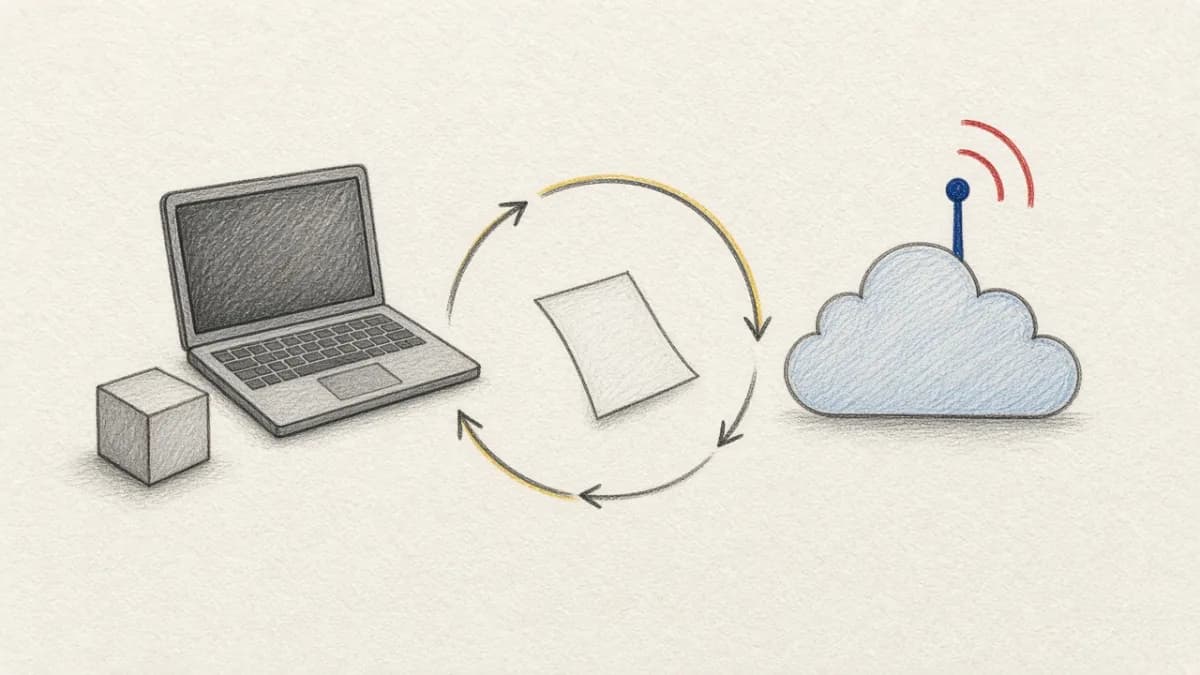
Building production-ready AI applications requires more than just model integration. It demands a robust data infrastructure that can handle the complexity of multimodal data, ensure incremental processing, and maintain type safety throughout the entire pipeline. At Pixeltable, we've architected a declarative AI data infrastructure that addresses these challenges head-on.
In this deep dive, we'll explore the architectural decisions, development patterns, and engineering principles that make Pixeltable a powerful foundation for AI application development. Whether you're building similar systems or looking to understand modern AI infrastructure design, this post will give you insights into how we've tackled some of the most complex challenges in the space.
The Declarative Philosophy#
Traditional AI workflows are often imperative: you write scripts that explicitly define every step of data transformation, model inference, and result storage. This approach breaks down quickly as applications scale, leading to complex dependency management, redundant computation, and brittle pipelines.
Pixeltable takes a fundamentally different approach: declarative data processing. Instead of writing scripts, developers define what they want computed, and our engine determines how to execute it efficiently.
This declarative model brings several key advantages:
- Incremental Updates: Only process new or changed data
- Automatic Dependency Tracking: Changes propagate through the pipeline automatically
- Optimized Execution: The engine can batch operations, push computations to SQL, and parallelize where appropriate
- Reproducible Results: Same declarations always produce the same results
Core Architectural Components#
Pixeltable's architecture is built around several key components that work together to provide a unified interface for multimodal data processing.
Unified Table Interface#
At the heart of Pixeltable is a table abstraction that handles both structured and unstructured multimodal data. Unlike traditional databases that struggle with complex data types, our tables natively support images, videos, audio, and documents alongside standard data types.
The type system is built on specialized column types that understand the semantics of different media formats:
pxt.Image: PIL.Image.Image objects with file URL storagepxt.Video: Video files with frame extraction capabilitiespxt.Audio: Audio data with waveform processingpxt.Document: Text documents with parsing supportpxt.Array: NumPy arrays for embeddings and vectors
Expression System#
Pixeltable's expression system provides SQL-like operations that work seamlessly with multimodal data. Expressions can be composed, chained, and optimized by our execution engine.
The expression system intelligently decides whether to push computation to SQL or evaluate in Python, enabling optimal performance across different operation types.
User-Defined Function (UDF) Framework#
The UDF framework is where Pixeltable's extensibility really shines. Developers can create custom functions that integrate seamlessly with the declarative system while maintaining type safety and performance.
Our UDF framework enforces several key principles:
- Type Safety: All UDFs must include type hints and return types
- Batching Support: Automatic batching for expensive operations
- Resource Management: Built-in rate limiting and connection pooling
- Error Handling: Graceful failure handling with context preservation
Execution Engine#
The execution engine is responsible for translating declarative specifications into optimized execution plans. It handles incremental computation, dependency tracking, and performance optimization.
Key features of the execution engine include:
- Incremental Processing: Only compute what's changed since last execution
- SQL Pushdown: Move computations to the database when possible
- Parallel Execution: Automatic parallelization of independent operations
- Resource Pooling: Intelligent management of API rate limits and connections
Development Best Practices#
Building a robust AI infrastructure requires strict development practices. Here are the key principles we follow at Pixeltable.
Type Safety First#
Every piece of Python code in Pixeltable includes comprehensive type hints. This isn't just for documentation. It's enforced by our CI/CD pipeline and enables powerful static analysis.
Comprehensive Testing Strategy#
Our testing strategy includes multiple levels of verification:
Tests are designed with several key principles:
- Parallel Execution: Tests run in parallel with automatic worker database assignment
- Automatic Retry: Flaky tests are retried automatically to handle timing issues
- Isolation: Each test worker gets its own database to prevent interference
- Comprehensive Coverage: Unit tests, integration tests, notebook tests, and stress tests
AI/ML Integration Patterns#
We've developed consistent patterns for integrating AI/ML services that ensure reliability, performance, and maintainability:
This pattern ensures:
- Automatic Rate Limiting: Resource pools handle API quotas
- Connection Reuse: Clients are managed centrally
- Error Handling: Consistent error propagation and retry logic
- Configuration Management: Environment-based client configuration
Performance & Scalability#
Performance is critical for AI workloads. Pixeltable employs several strategies to ensure optimal performance across different scales and use cases.
Intelligent Batching#
Many AI operations benefit from batching, but the optimal batch size varies by operation type, hardware, and data characteristics. Pixeltable automatically handles batching based on UDF declarations:
SQL Pushdown#
When possible, Pixeltable pushes computations to the PostgreSQL database, leveraging its optimized query engine:
Resource Pooling#
AI services often have rate limits and connection constraints. Pixeltable's resource pooling system manages these automatically:
Real-World Applications#
The architectural decisions we've made enable powerful real-world applications. Here are some examples of how these patterns come together:
Multimodal RAG System#
Video Analysis Pipeline#
Getting Started with Development#
Setting up a development environment for Pixeltable follows our established patterns for reproducibility and developer experience:
Essential Development Commands#
Future Architecture Directions#
As AI infrastructure continues to evolve, we're exploring several architectural enhancements:
- Distributed Execution: Scaling beyond single-machine processing
- Advanced Optimization: Query planning and cost-based optimization
- Multi-Cloud Support: Seamless integration across cloud providers
- Real-time Processing: Streaming data support for live applications
Building the Future of AI Infrastructure#
The architectural decisions behind Pixeltable reflect our core belief: AI infrastructure should be declarative, type-safe, and optimized for developer productivity. By treating data transformations as first-class citizens and providing a unified interface for multimodal data, we've created a foundation that scales from prototypes to production.
The patterns and practices we've shared (from declarative processing to comprehensive testing) represent hard-learned lessons from building production AI systems. As the AI landscape continues to evolve, these architectural principles provide a stable foundation for innovation.
Whether you're building your own AI infrastructure or evaluating existing solutions, we hope these insights help you make informed decisions about architecture, development practices, and performance optimization. The future of AI applications depends on robust, scalable infrastructure, and we're excited to be pushing the boundaries of what's possible.
Ready to experience declarative AI infrastructure firsthand? Explore Pixeltable on GitHub and see how our architectural decisions translate into developer productivity and application performance.