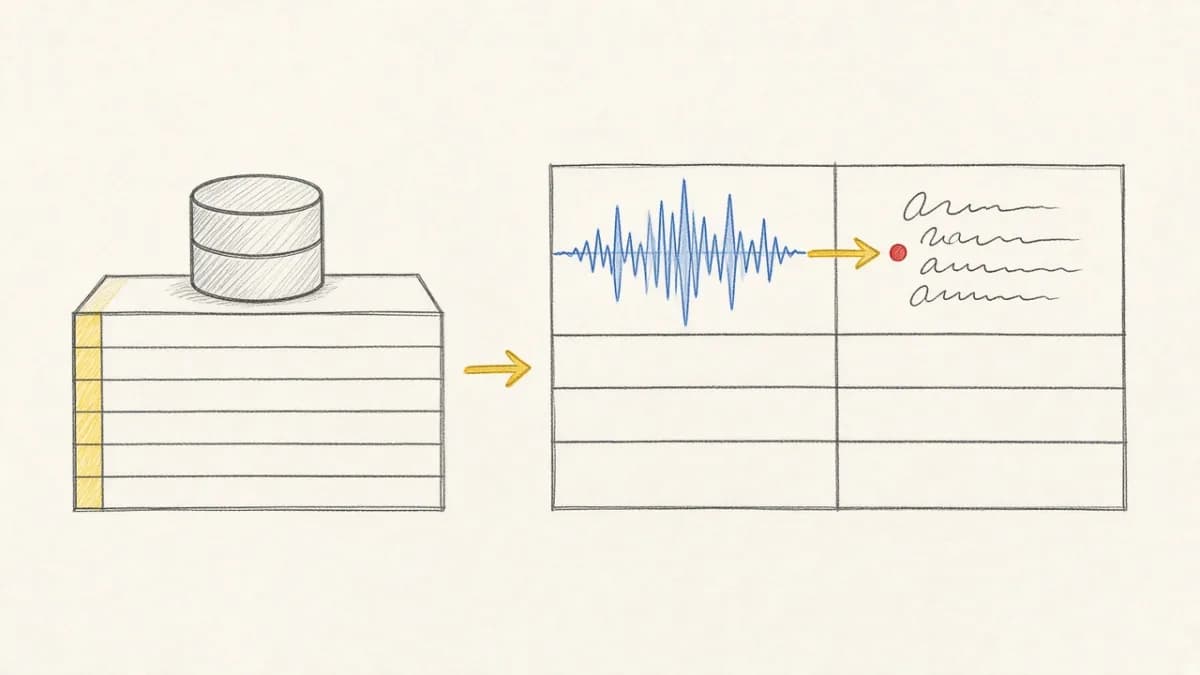
The Feature Store Revolution, and Its Limits#
Feature stores like Feast, Tecton, and Databricks Feature Store solved a real problem: managing the features that feed machine learning models. They brought consistency between training and serving, reduced duplicate feature engineering, and enabled feature reuse across teams.
But here's the challenge: feature stores were designed for structured data and traditional ML. When your AI application involves images, videos, audio, documents, and LLMs, the feature store paradigm starts to break down.
This isn't a knock on feature stores; they're excellent for their intended purpose. It's a recognition that multimodal AI needs a fundamentally different approach.
What Feature Stores Do Well#
Let's give credit where it's due. Feature stores excel at:
1. Training-Serving Consistency#
Feature stores ensure the same feature computation logic runs during training and inference, preventing training-serving skew.
2. Point-in-Time Correctness#
For time-series features, feature stores handle the complexity of joining features at the correct historical timestamp.
3. Feature Discovery and Reuse#
Teams can browse a catalog of existing features instead of rebuilding them from scratch.
Where Feature Stores Struggle#
Now let's look at where the feature store model breaks down for modern AI:
❌ Unstructured Data#
Feature stores expect tabular data with numeric and categorical features. They weren't designed for:
- Raw images that need preprocessing
- Videos that need frame extraction
- Documents that need parsing and chunking
- Audio that needs transcription
❌ Transformation Pipelines#
Feature stores manage computed features, but the computation happens elsewhere. You still need external ETL (Airflow, Spark, dbt) to produce those features.
❌ Embeddings and Vector Search#
While some feature stores now support vectors, they typically don't include:
- Built-in embedding generation
- Vector similarity search
- Automatic re-embedding when source data changes
❌ LLM Integration#
Feature stores have no concept of LLM calls, prompt management, or generated content.
The Pixeltable Approach: Unified Data Layer#
Pixeltable takes a different approach: instead of being a feature store, it's a complete data layer that handles storage, transformation, and serving in one system.
Head-to-Head Comparison#
| Capability | Feature Stores | Pixeltable |
|---|---|---|
| Data Types | Numeric, categorical, arrays | Images, video, audio, documents + all standard types |
| Feature Computation | External (Spark, dbt, Airflow) | Built-in computed columns |
| Storage | Separate (S3, data warehouse) | Integrated storage layer |
| Embeddings | Store vectors (no generation) | Generate + store + index + search |
| LLM Integration | None | Native OpenAI, Anthropic, Gemini, etc. |
| Incremental Updates | Batch recompute | Automatic incremental processing |
| Versioning | Feature versioning | Full data + schema versioning |
| Online Serving | Yes (low-latency lookup) | Yes (query interface) |
| Training-Serving Consistency | Core strength | Same computed columns everywhere |
When to Use What#
✅ Use a Feature Store When:#
- You have tabular/structured data exclusively
- You need low-latency feature serving (<10ms)
- You have existing Spark/data warehouse pipelines you want to leverage
- Your team is already invested in the MLOps ecosystem (MLflow, Kubeflow)
- You're building traditional ML models (XGBoost, logistic regression)
✅ Use Pixeltable When:#
- You're working with multimodal data (images, video, audio, documents)
- You're building LLM-powered applications (RAG, agents, chatbots)
- You want one system for storage + transformation + serving
- You need automatic embedding management
- You're prototyping and need to move fast
- You don't want to manage separate ETL pipelines
Migration Example: Feast to Pixeltable#
If you're considering moving from a feature store to Pixeltable, here's how the concepts map:
The Multimodal Advantage#
Here's something you simply can't do with a feature store: a complete multimodal product catalog:
Real-World Scenario Comparison#
Scenario: E-commerce Recommendation System#
With Feature Store + Traditional Stack:
- Store product images in S3
- Run Spark job to compute image embeddings → store in data warehouse
- Ingest embeddings into feature store
- Deploy separate vector search service
- Write serving code to join features + search results
- Set up Airflow DAG to keep everything in sync
With Pixeltable:
- Create table with image column
- Add computed column for embeddings
- Add embedding index
- Query directly
Conclusion#
Feature stores and Pixeltable solve different problems:
- Feature stores are specialized tools for managing structured ML features with strong online serving guarantees
- Pixeltable is a unified data layer for multimodal AI that handles the entire pipeline from raw data to queryable features
If you're building traditional ML on structured data, feature stores remain excellent choices. But if you're building modern AI applications with images, video, documents, and LLMs, you need a tool designed for that world.
The future of AI isn't just about managing features; it's about managing the entire data lifecycle for multimodal content. That's what Pixeltable was built for.