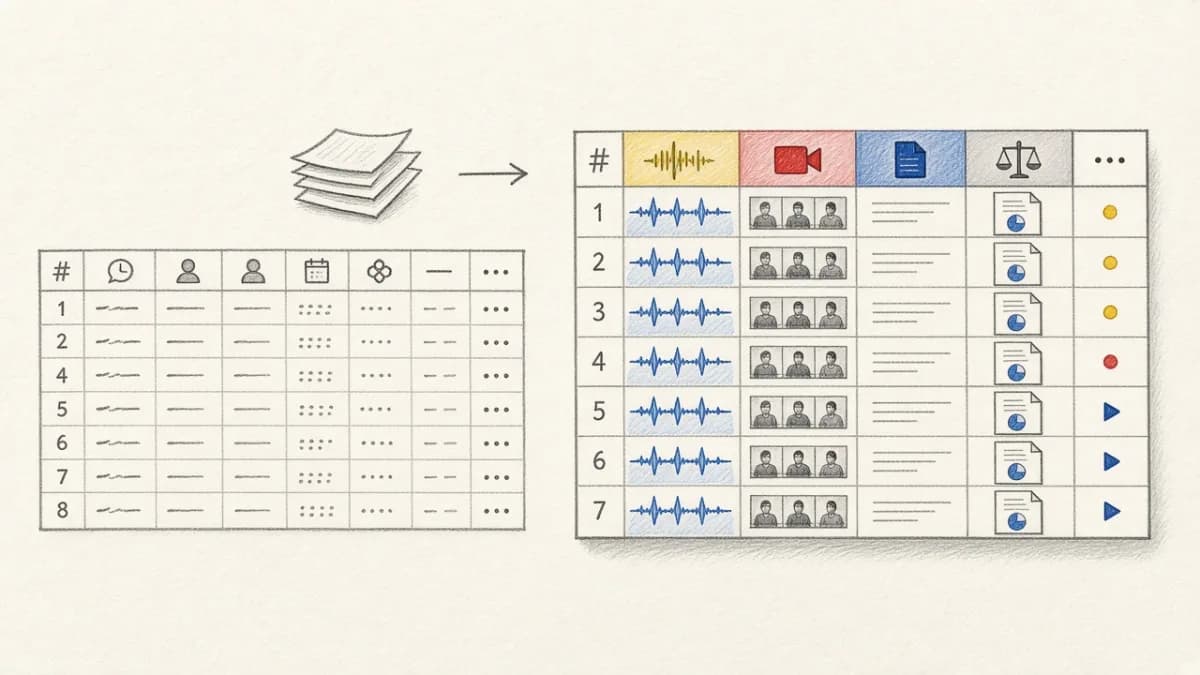
The "Modern Data Stack" revolutionized analytics. But when you bolt it onto multimodal AI workloads (video processing, RAG pipelines, agent memory), you end up maintaining five services, 2000 lines of glue code, and a system where changing your embedding model means an 8-hour migration. Here's how to migrate to infrastructure designed for AI.
Why You Built This Stack#
Let's be honest: the stack you have today wasn't a mistake. You built it because each component solved a real problem:
- S3/GCS: Cheap, durable blob storage. Where else would you put 10TB of video?
- Postgres: Battle-tested for metadata. You know SQL.
- Pinecone/Weaviate: Fast vector similarity search. The RAG tutorial said to use it.
- Airflow/Prefect: Your data engineers already knew it from analytics pipelines.
- Redis: Caching layer because the LLM calls are expensive.
Each tool is excellent at its job. The problem isn't the tools. It's that they weren't designed to work together for AI workloads.
The Architecture You Have Now#
Here's what the typical "modern" AI stack looks like in production:
Count the services: S3, Postgres, Pinecone, Airflow, Redis. That's 5 services to operate, monitor, and pay for, before you write a single line of AI logic.
Where This Breaks for AI Workloads#
The Modern Data Stack was designed for analytics: batch SQL queries over structured data. AI workloads are fundamentally different:
Problem 1: No Transactional Consistency#
When you insert a video, you need to:
- Upload the file to S3
- Insert metadata into Postgres
- Extract frames, generate embeddings, upsert to Pinecone
If step 3 fails halfway, you have zombie records: metadata pointing to embeddings that don't exist. Your RAG app returns broken results. There's no transaction spanning S3 + Postgres + Pinecone.
Problem 2: The Model Change Nightmare#
Your team wants to switch from text-embedding-ada-002 to text-embedding-3-large. Here's your current process:
Cost: ~$500 in compute, 8 hours of downtime risk, and a week of engineering time. This happens every time you change a model.
Problem 3: No Lineage#
Six months from now, someone asks: "Which model version generated these embeddings? Were they computed before or after we fixed the preprocessing bug?"
You don't know. There's no lineage connecting the output (embeddings in Pinecone) to the inputs (files in S3) and the code (which version of your embedding function ran).
Problem 4: Orchestration Doesn't Understand Data#
Airflow knows when to run tasks. It doesn't know what needs to recompute. When you add a new row, Airflow doesn't automatically process just that row. You write custom logic to detect changes and trigger the right tasks.
What Multimodal AI Actually Needs#
AI workloads have specific requirements that the Modern Data Stack wasn't designed for:
| Requirement | Modern Data Stack | What AI Needs |
|---|---|---|
| Consistency | Eventually consistent across services | Transactional across media, metadata, vectors |
| Updates | Full re-process on change | Incremental recomputation |
| Orchestration | Schedule-based (cron, DAGs) | Data-aware (change triggers compute) |
| Lineage | DIY or nonexistent | Automatic, queryable |
| Storage | Separate systems for each data type | Unified for media, metadata, vectors |
The Migration Target: Declarative Data Infrastructure#
Here's the same architecture after migration to Pixeltable:
What changed:
- 5 services → 1: Pixeltable replaces S3 sync, Postgres, Pinecone, Airflow, and Redis
- 2000 LOC glue code → 0: Orchestration, caching, retries are built-in
- Your application code is unchanged: FastAPI still talks to a Python backend
A Real Pipeline: Before and After#
Let's look at a concrete example: a multimodal video processing pipeline that extracts audio, transcribes it, generates a hook, and creates a final video.
Before: The Frankenstein Approach#
After: Pixeltable#
Lines of code: ~30 (your logic) vs. ~1000+ (Airflow + glue)
What you didn't write:
- DAG definition and task dependencies
- Retry logic with exponential backoff
- Rate limiting per API provider
- Caching of intermediate results
- Error handling and dead letter queues
- S3 upload/download utilities
The Incremental Advantage#
Here's where Pixeltable fundamentally differs from the traditional stack.
Scenario: You want to switch from Whisper to a faster transcription model.
Traditional Approach#
Pixeltable Approach#
The Migration Path#
You don't have to rewrite everything at once. Here's a practical 4-week migration:
Week 1: Shadow Mode#
Run Pixeltable alongside your existing stack. Mirror writes to both systems.
Week 2: Validation#
Compare outputs. Verify Pixeltable produces identical results.
Week 3: Cutover#
Switch reads to Pixeltable. Keep the old stack as fallback.
Week 4: Cleanup#
Remove old infrastructure. Delete the glue code. Cancel the Pinecone subscription.
What you delete:
- Airflow DAGs and workers
- Redis cluster
- Vector database subscription
- 2000+ lines of glue code
- 3am pages when the sync script fails
FAQ#
Can I keep my existing S3 storage?#
Yes. Pixeltable references files in place, with no data migration required. Your S3 buckets remain the source of truth.
What about my existing embeddings?#
You can import them directly into Pixeltable. No need to recompute unless you want to change models.
How does this affect my application code?#
Your FastAPI endpoints, React frontend, etc. are unchanged. You're replacing the data layer, not the application layer.
What's the learning curve?#
If you know Python and SQL, you can be productive in an afternoon. The API is intentionally familiar: tables, columns, queries.
Stop Maintaining Infrastructure. Start Shipping AI.#
The Modern Data Stack was a revolution for analytics. But AI workloads need infrastructure designed for AI: incremental computation, transactional consistency across media types, and automatic lineage. The post-AI data stack still stops at tagging unstructured data into SQL—Pixeltable is the table for the rest.
You didn't become a data engineer to maintain five services and 2000 lines of glue code. Migrate to infrastructure that handles the plumbing so you can focus on the AI.
Ready to start? Check out the Quick Start or see how other teams are switching from vector databases.